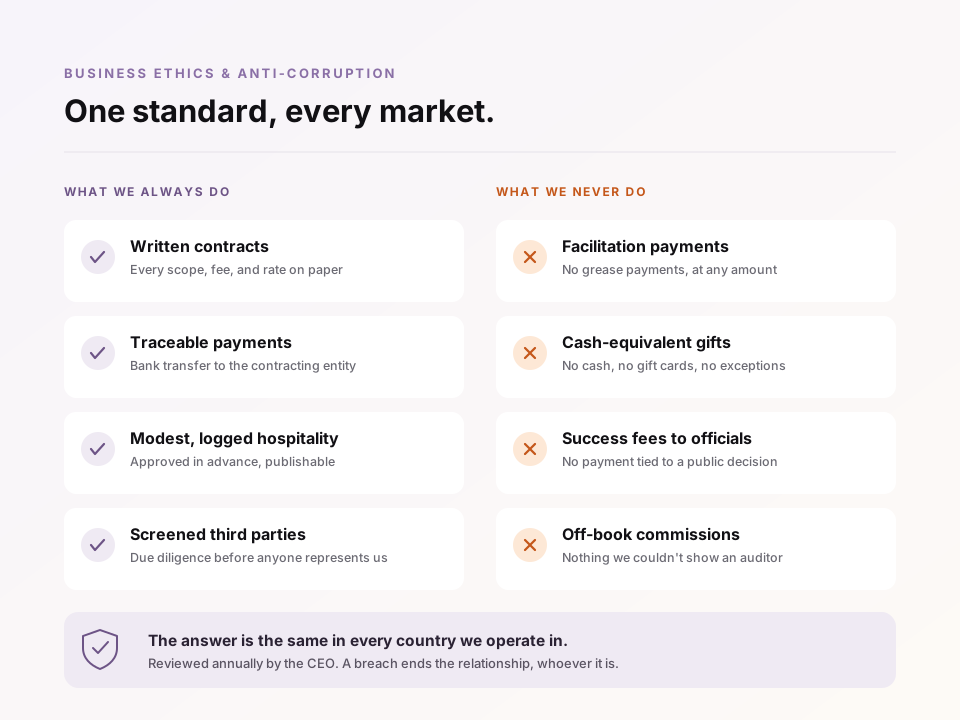
NETLINKS prohibits bribery and corruption in every country we work in. We do not offer, give, request, or accept anything of value to win business or influence an official decision. We do not make facilitation payments. We do not pay a commission that isn't in a signed contract and on an invoice for real work. This page is that policy, in full.
Who this applies to
Everyone who acts for NETLINKS Ltd: employees, contractors, interns, agents, resellers, referral partners, subcontractors, and joint-venture partners, in every country where we deliver. Our contracts flow this standard down to third parties, and a third party's breach on our behalf is treated as our own.
The standard we hold ourselves to
We operate under Afghan law prohibiting the bribery of public officials, and under the anti-corruption obligations our international clients and donors pass down to us. Much of our work is for organizations bound by the US Foreign Corrupt Practices Act, the UK Bribery Act 2010, and the procurement and anti-fraud rules of institutions such as the World Bank, the United Nations, the European Union, and bilateral donor agencies. Those obligations reach us as a supplier, and we build our controls to satisfy them rather than to meet the local minimum.
Where two standards differ, the stricter one applies. Local custom is not a defence, and "everyone here does it" is not a business case. If holding this line costs us a deal, that is the correct outcome, and it does not count against the person or the team who held it.
What is never allowed
- Bribes, in either direction. Offering, promising, giving, requesting, or accepting anything of value to obtain or retain business, or to influence any official or commercial decision.
- Facilitation payments. No "grease payments" to speed up a routine permit, clearance, visa, or inspection, at any amount, in any country.
- Cash and cash-equivalents. No cash, gift cards, prepaid cards, cryptocurrency, or vouchers to anyone outside our own payroll, at any value.
- Payments we can't trace. No payment where we don't know the ultimate recipient, and none routed through an account that isn't the counterparty's own.
- Success fees to officials. No finder's fee, commission, or contingent payment to a public official, their relative, or an entity they control or benefit from.
- Kickbacks. No personal payment or benefit to a client employee for awarding, renewing, or approving our work.
- Donations used as leverage. No charitable donation or sponsorship requested by, routed through, or credited to anyone with influence over a decision that involves us.
- Jobs as favours. No hiring, internship, or contract for the relative or nominee of a client or official as consideration for a decision.
One exception, and only one. If personal safety is genuinely at risk, comply, get to safety, then report it to the Compliance Officer within 24 hours. The payment is recorded accurately in our books for what it was. Nobody is disciplined for choosing their safety, and nobody is excused for claiming duress that wasn't there.
Gifts, hospitality, and entertainment
Modest hospitality is a normal part of business. It stops being modest the moment it could reasonably look like it bought something. Four questions decide it, and all four have to come back yes.
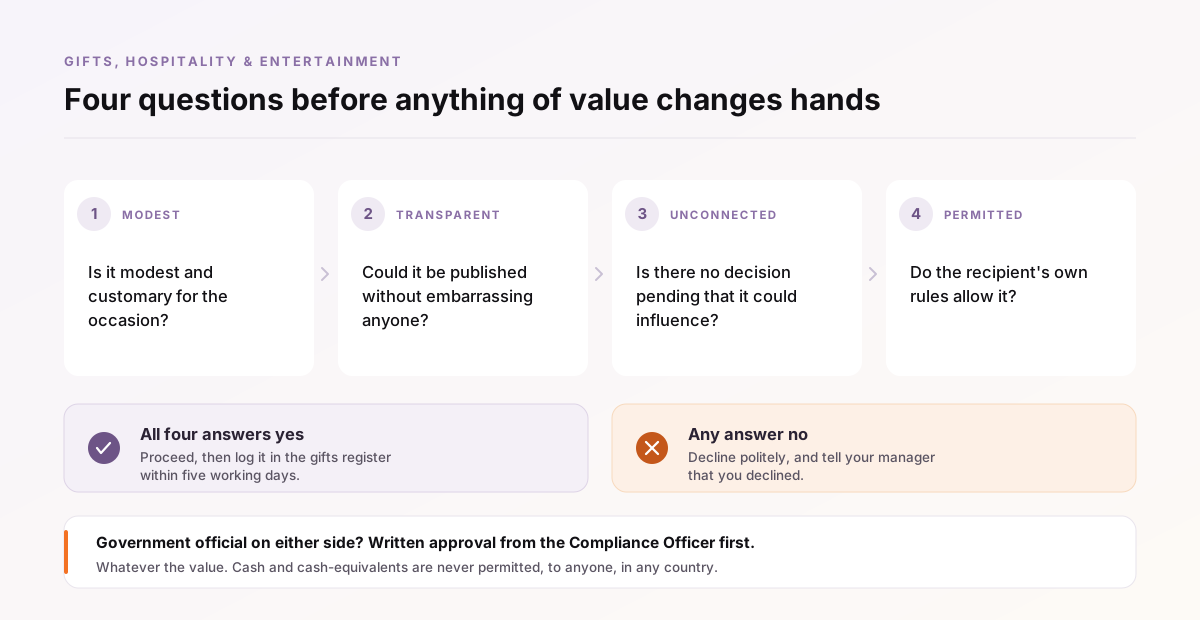
Approval thresholds, per person, per occasion:
- Under USD 50. Ordinary business meals and branded items. No pre-approval needed.
- USD 50 to 150. Written manager approval in advance, logged in the gifts register.
- Above USD 150. Written Compliance Officer approval in advance.
- Any government official, any value. Written Compliance Officer approval in advance, without exception.
- During a live tender, evaluation, or renewal. Nothing at all, to anyone on the buying side, not even a meal.
Never permitted regardless of value: cash and cash-equivalents, anything for the personal benefit of a decision-maker (school fees, personal travel, home goods, medical bills), and anything the recipient's own employer forbids. Received gifts follow the same test, and anything that fails it is returned with a short, polite note explaining our policy.
Government officials and public-sector work
We read "government official" widely. It includes employees of national, provincial, and municipal bodies, state-owned enterprises and public utilities, central banks and regulators, public universities and hospitals, officials of international organizations, political parties and candidates for office, and anyone acting on their behalf. Close family members are treated the same way.
- Travel or accommodation for an official is arranged only under a written agreement with the institution, booked and paid by us directly, economy class, no side trips, no per-diem paid to an individual, and only where the travel has a genuine business purpose.
- During a live procurement, all contact runs through the buyer's official channel. No private meetings, no informal previews of pricing, no gifts, no hospitality.
- We do not offer employment or internships to an official or their relative while a decision involving us is open.
- Where an official asks for something this policy forbids, the answer is a clear no, the request is logged, and the Compliance Officer is told the same day.
Commissions, agents, resellers, and referral partners
Third parties are where most corruption risk actually sits, so intermediaries carry the heaviest controls we have. Nobody represents NETLINKS or earns a commission from us until all of this is done.
- Written contract first. Scope, deliverables, rate, and payment terms agreed and signed before any work starts. No retrospective paperwork.
- Commercially reasonable fees for real services. Compensation reflects work actually performed. We do not pay a percentage of a public contract award, and we do not pay round-sum "consulting fees" with no described deliverable.
- Due diligence before appointment. Legal identity, registration, and beneficial ownership verified. Screening against sanctions lists (OFAC, UN, EU, UK) and multilateral-development-bank debarment lists. Politically-exposed-person check. References taken, conflicts declared in writing.
- Payment discipline. Paid against an invoice describing the actual service, to the counterparty's own bank account in its country of business. No cash, no third-party accounts, no unrelated offshore accounts, no payment in a jurisdiction with no connection to the work.
- Contract clauses. Anti-bribery representations, the right to audit relevant records, and the right to terminate immediately on breach, in every intermediary agreement.
- Re-screened annually, and immediately on any red flag.
Red flags that stop an appointment or a payment until they're resolved: the party refuses anti-bribery terms; asks to be paid in a third country or to an account in another name; requests an unusually large fee, or a large advance in cash; was recommended by the official deciding the award; cannot explain what they will actually do; or will not disclose who owns them.
Political contributions, donations, and sponsorships
NETLINKS makes no political contributions in any country, in money or in kind. Employees are free to participate in political life personally, on their own time and with their own money, without using the NETLINKS name, premises, or resources.
Charitable donations and sponsorships are permitted with written approval. The recipient must be a real, registered organization, the payment goes to the institution rather than an individual, the purpose is documented, and the donation is never made at the request of, or credited to, anyone with influence over a decision involving us.
Conflicts of interest
A conflict isn't misconduct. Hiding one is. Declare outside employment or consulting, family or close personal ties to a client, vendor, competitor, or official, ownership stakes in a supplier or competitor, personal relationships inside a reporting line, and outside board seats. Declarations are recorded, and the person declaring steps out of the related decision.
Books, records, and internal controls
- Every transaction is recorded accurately in our own Odoo ERP, in the correct period and to the correct account. No off-book accounts, no unrecorded funds, no vague or false descriptions, no inflated invoices.
- Separation of duties: whoever approves an expense is not the person who releases the payment. Bank transfers above threshold require dual authorization.
- Vendor bank-detail changes are verified out of band, by phone to a previously known number, before any payment is released.
- Expense claims require receipts, the business purpose, and the names of everyone present.
- Financial and compliance records are retained for seven years.
- Delivery is governed by our group's ISO 12207 certification and information security by ISO 27001, and the control evidence behind both is available to client and donor auditors for the engagements they fund.
Sanctions, screening, and money laundering
Clients, partners, vendors, and intermediaries are screened against OFAC, UN, EU, and UK sanctions lists and against multilateral-development-bank debarment lists at onboarding and annually thereafter. We do not engage with sanctioned parties. Payments move through the banking system, in the contracting entity's name, against an invoice. We do not accept cash settlement of invoices, payment from an unrelated third party, or payment in cryptocurrency.
Speaking up
If something looks wrong, say so early, when it's still a question rather than an incident. Raise it with your manager, or go directly to the Compliance Officer at compliance@netlinks.af, or to the CEO. Clients, partners, suppliers, and members of the public can use the same address.
- Anonymous reports are accepted, and they are acted on.
- We acknowledge within five working days and investigate through someone independent of the matter.
- Where the law allows, we tell the reporter what came of it.
- No retaliation. Retaliating against anyone who reports in good faith is itself a disciplinary offence, and it applies equally to a report that turns out to be mistaken.
Training, monitoring, and review
Every new joiner completes anti-corruption training within 30 days of starting. Client-facing, procurement, and finance staff repeat it annually. Each year we review the gifts register, intermediary payments, and expense claims for patterns, and we refresh third-party screening. The policy itself is reviewed annually and approved by the CEO, who is the final escalation point for anything raised under it.
If we get it wrong
Breach by an employee leads to disciplinary action up to and including dismissal. Breach by an agent, reseller, or subcontractor ends the contract. Where a client, donor, or authority has to be told, we tell them, and we would rather report ourselves than be found. Individuals should also understand that bribery carries personal criminal liability in most of the jurisdictions we work in, and a company policy is not a shield against it.
Contact
Compliance questions, due-diligence requests, and reports: compliance@netlinks.af. For procurement teams, we can supply this policy signed on NETLINKS Ltd letterhead, a completed vendor due-diligence questionnaire, and the anti-bribery clause we're prepared to sign. See also our privacy policy, our delivery methodology, and who we are.